• Skip to main content
  • Skip to primary sidebar

Bradley James Weber

Startling Stories for All Ages

  • Books
  • Stories
  • 24-Hr Comics
  • Blog
  • Art
  • About

Art

Max Allan Collins and the Case of the Sucky Book Cover

August 25, 2011 By Bradley Weber

The original draft of the Junior Mad Scientist review of Bye, Bye, Baby included a drubbing of book’s the less-than-stellar cover art that made crappy by association what was really a quality read. Rather than risk splashing the text while pissing on the cover, all discussion of the upfront image was removed and saved for later.

Wella, well . . . poking around Max Allan Collins’s Website, it seems the man himself is none too pleased with what will be people’s first impression of his latest work:

“I’ve stirred some interest and even commentary on my admitted displeasure with the cover to the new Heller. I am pleased by the quality of the photograph, and thrilled that my publisher ponied up for a major photographic shoot from the excellent Thalicer Image Studio. But because of fears that the MM estate might object to too overt a Marilyn image, the publisher chose what I consider to be the weakest (and certainly most historically inaccurate) of the photos from the shoot.”

Since the other cover options are not available for review, it’s hard to argue with him. And while the chosen cover is flaccid and dull, it manages to attract the eye and direct it around the primary sights. Here are the excised chunks of the of the original review with full analysis of how the image works.

POST 08152011 SITE=JMS +++ EMAIL PUB W/LINK

HEADLINE –– Book Review: Bye, Bye, Baby by Max Allan Collins

(INSERT COVER)

A good book with a bad cover is like a dead kitty on the tollway. Driving past it, you wonder who was supposed to be taking care of the forlorn thing, think it deserved better, then wonder how long it’s going to lay there. Max Collin’s latest Nate Heller memoir Bye, Bye, Baby is that dead kitty.

[Hey, it’s me again. Just so you know, the majority of the review –– all the stuff about how good the text is, etc. –– came from right here. OK, roll tape.]

Staged photos like this, especially on a fiction cover, are less effective than an auctioneer with a bad stutter. The photo on Bye, Bye, Baby lacks not only luster, but nearly anything related to the story inside. (The title is one of Marilyn’s songs from Gentlemen Prefer Blondes; that point goes to Collins, not the book’s designers.) More than probably, the lack of relevance is due to Marilyn’s image or likeness being heavily copyrighted and/or trademarked, and the publisher not wanting to shell-out for using it. Not that I blame them; that kind of thing has got to be expensive. And with publishing costs being what they are today, if there’s a reason and a way to avoid adding to the overhead, all to the good.

Which gets us back to an illustrated cover. Any talented artist could have pulled off something really intriguing that more heavily hinted at, but didn’t show, the corpsified Marilyn, and for a lot less than the cost of staging a shoot.

And while there are several other gripes about the photo –– including the inaccurate death scene and the fedora-sporting geezer eyeballing the dead girl’s ass –– the time has come for it’s one and only good point: an effective use of space and white to guide the eye.

Stay with me here . . .

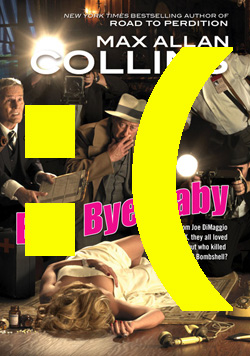
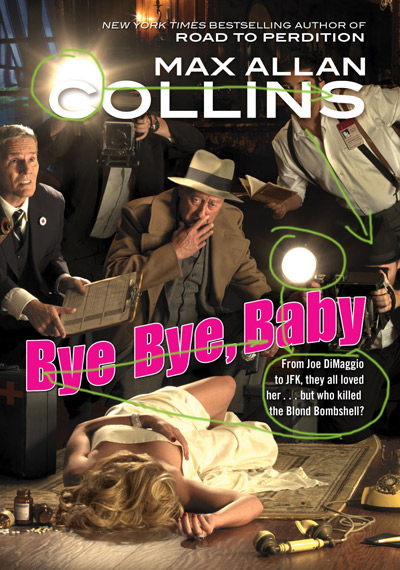
The starburst camera flash in the upper left corner attracts the eye and drags it across the white of the author’s name to the reporter’s black suspenders framing his white shirt; the V of his open collar, the shirt buttons, suspenders and the angle of his torso draw the viewer’s eye down to the second camera flash a fraction of an inch above the hot pink title –– also outlined in white. From here, the eye might go two directions: flick along the lilting title back to it’s beginning or down to read the single sentence synopsis below before taking in the title. The second scenario seems most likely because those letters are also in white.
Either way, the title will be read because the panicky-looking guy in the suit to the left, just under the flashblown C. His highlit hair, white teeth, white collar, the white slashes in his tie, the lapel button, the lined papers on the angled clipboard and the index finger of his right hand lead the eye down to the dead girl with the nice rack. And oh, look –– there’s a hot pink title between his finger and her chest.
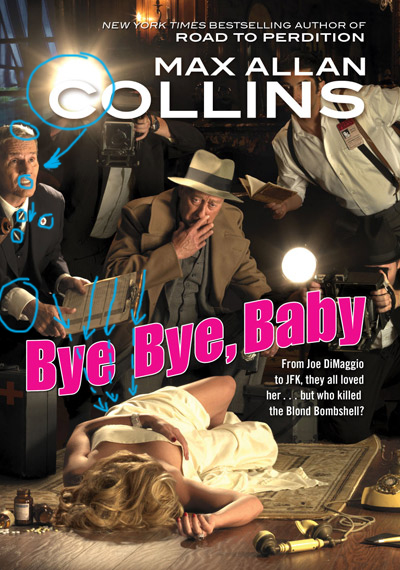
Along with her ample bossoms (which are strangely free of cleavage), the dead girl’s glittering bracelet, satin sheet and telephone receiver conspire to draw the eye down and through the image. Note the ivory colors and off-white tones of the sheet, rug and phone. This is because the body is the eye’s final resting place (as it were), not where the eye should start.

But look how the angle of the girl’s knee directs the eye back up to the white camera flash again, and how the title gets in the way. Funny how that works.

Central to all this is the septuagenarian detective –– who looks nothing like the fiddle–fit Heller described in the book.
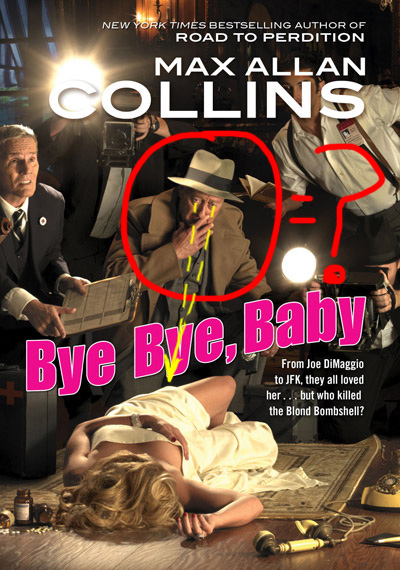
Sure, Heller wears suits — also sporty casual clothes, polo shirts, white jeans — and admits forgoing hats thanks to the trend set by JFK. Who this moist-eyed basset hound is supposed to be is anyone’s guess. LAPD, maybe? If you look reeeeeeeal close, he’s holding a badge.
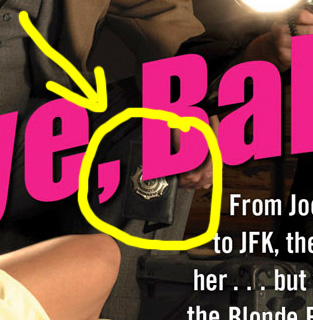
So confused . . . .

Knowing the mechanics of the cover still doesn’t make readers/buyers unfamiliar, or even slightly familiar, with Heller or Collins want to pick it up. Because the cover is boring and displays almost nothing of the real mystery inside.

And why there isn’t a well-placed banner showcasing this as A NATE HELLER MYSTERY, I can only imagine. Most readers like a good series. The Heller memoirs may not be what anyone would consider a traditional mystery series, but after more than a dozen books, that’s pretty much what it is. When you’ve got a nice backlist, why not show it off?

For those who read it and recognize it, an author’s name can overcome uninspired, barely functional cover art. In some cases, the author’s name is all that’s needed: Stephen King, James Patterson, Amanda Quick, Dan Bown.

(. . . gag . . . ack . . . Sorry. Threw up a little in my mouth on that last one.)

Unfortunately, Max Allan Collins doesn’t have quite that level of recognition. Christ only knows why. It’s not like he doesn’t deserve it. Perhaps it has something to do with publishers wrapping his books in crappy cover art.

Still and all, beyond an author’s brand name, a good cover is what gets a book into people’s hands. Hell, even wine makers know this. Over the last several years, label design has gone through a major shift because what’s true of books is true of wine: buyers judge contents by what’s on the outside. (This is also true of mail-order brides –– though that industry has a narrower consumer base than the other two up for discussion.)

Good art on bad wine sells a lot of bad wine. Bad art on good books sells damned few good books.

Bye, Bye, Baby deserves much better than it got. Here’s hoping the paperback gets the right treatment.

(28 FEB 2012: comments section closed due to excessive spam. Please direct any comments to the address on the ABOUT page. Thanks. bjw)
Filed Under: Art, Book Reviews, JMS Labs

Steadman’s Children’s Book Art

December 2, 2010 By Bradley Weber

Both of these books are long overdue. Not from publishers, from the library. They were checked out three weeks ago, read within days and have been sitting on my desk since then. So instead of being paid to review these, I’m now paying twenty-five cents a day per book. It’s tough that gold, not irony, is coin of the realm otherwise I’d be able to afford that flying pony Kidzilla wants for xmas.

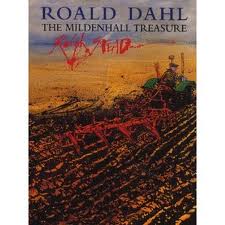
There is no reason to spend much time on the texts. The Big Red Squirrel and the Little Rhinoceros was written by a Swiss publisher and is, despite its hyperbolic jacket text, pure crap. The Mildenhall Treasure is some decent reporting by Roald Dahl about a plowman’s January 1942 discovery of ‘the greatest treasure ever found on the British Isles.” The dwelling point here is Steadman’s styles in children’s book illustration separated by 35 years of craft and the effects of his being the birthing partner of Gonzo Journalism.

Published in 1999, The Mildenhall Treasure’s two–dozen illustrations are typical of Steadman’s well known style: thoughtful composition balanced with loose, seemingly frenetic, brushwork. His art here is a meatier, amped-up and menacing version of the skewed whimsy Quentin Blake did for most of Dahl’s other children’s books. For this story, Steadman’s style, not Blake’s, is the better fit.  Steadman’s merciless portrayal of people reveales their deeper natures; his environmental palate is dark, muddy, and cold –– nicely mirroring the actual dirt of a winter farm and the moral grime of that greedy bastard, Sydney Ford.

The one thing Steadman’s style fails to showcase is the treasure’s true value — the fine craftsmanship of each of the recovered pieces. Images of the treasure seem to be cut outs from a museum catalog or enlarged photocopies gouached over to less-than-stellar effect. Random House targeted this book for kids. Younger readers will likely have a hard time figuring out what Steadman’s pictures of the treasure are supposed to depict.

Why Steadman didn’t use actual photos or execute clear and representative drawings, I don’t know. There is likely some bullshit copyright/intellectual property reason the British Museum wouldn’t clear images of the treasure for this book. Too bad. Those photos with Steadman’s paintings and Dahl’s text would have been a powerful combination.

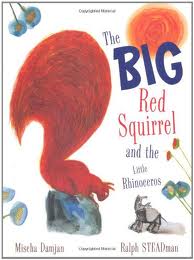
The same cannot be said for The Big Red Squirrel. Steadman’s art is the only rationale this boring, hollow, let’s-all-get-along tale is back in print after 45 years.

This not so much a picture book –– where the words and images work together to create greater meaning –– as an illustrated story. The text spells everything out, leaving the artist to decorate the white space around the words. Ralph seems to have done the best he could with what he’d been given, managing to deliver better art than the story deserved.

Gouaches and inks were Ralph’s mediums for this book, too. And while there is a certain looseness, the paintings are still well-mannered. Few people familiar with his Gonzo and post-Gonzo styles would be able to pick these out of a line-up of his work.  The crocodile and frog are the most memorable and many of the background animals are fun and eye-catching. The rest of the animals and many of the environments are muddy, uninspired and forgettable. Combine that with the puerile narrative and The Big Red Squirrel becomes less a curiosity than a boring artifact.

Filed Under: Art, Book Reviews, Fear & Loathing, JMS Labs, Kid's Stuff Tagged With: children's books, Gonzo art, Mildenhall Treasure, Ralph Steadman, Roald Dahl, Steadman

Covering the story

November 5, 2010 By Bradley Weber

This whole Web site thing has gotten out of control. It was supposed to be simple — a place for people to read the story, comment, and toss a few shekels in the hat if they were so inclined. But now . . . .

It’s my own damn fault, as these things tend to be. A half-dozen long attempts have been made to finish this paragraph, but it all devolves into more personal info than would be wise to share here. And really, who cares? This isn’t about me, it’s about the work. Sometimes that’s the same thing, but not today.

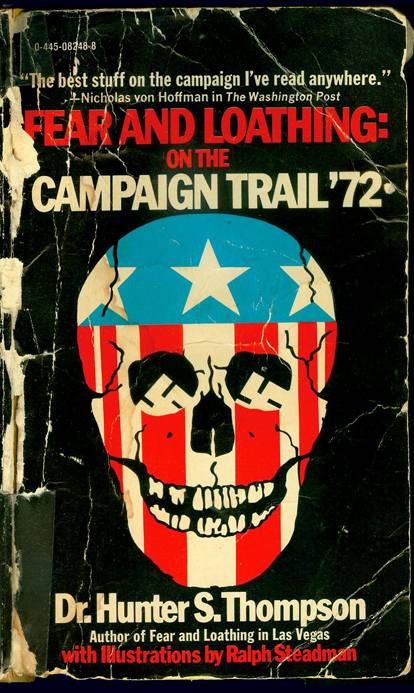
In 1990, I paid a whole buck-fifty for this copy of the campaign book. The El Cajon bookshop I bought it from has since shut its doors, though they seem to have a thriving online store.  The cover was in a lot better shape back then and pages didn’t smell like stale cigarettes.

From the very beginning, the title for my story was going to be Fear and Loathing of the Undead ’78. It immediately sets the tone and nails the action to a specific — and, I believe, critical — time in Hunter’s life. So when faced with having to create visuals for this site, Thomas Benton‘s iconic cover seemed like a good place to start riffing. His imagery is elegant and powerful: death, politics, America, Nixon, fear and loathing. The pieces started falling into place and I knew I was heading in the right direction.

Work started in early October. The image below is, for the most part, first-draft stuff. Except for the hands. I suck at drawing hands, so they took the longest to get just right. Then it was a matter of tinkering with the text.

For those who can spot these things, and there are many of you, I had to use News Gothic. It doesn’t quite match — not thick enough — but it’s the closest thing in the system right now. News Gothic Black or News Gothic Black No. 2 should do it, though I’m open to suggestions.

Keeping the text as close as possible to that on the campaign book was important. As good as the “Author of . . .” line looked under Hunter’s name, I was advised to take it out — a worry over using someone else’s work to promote my own. If anybody would know about that kind of thing, it’s Agent Joe, so the line was yanked.

Aging the cover was a last-minute a fuck-around. I saw the bashed-to-hell copy laying on my desk, liked the look and asked the wife if she knew how to do that kind of thing. She said no, but would look into it. She’s good like that. Meanwhile, I started messing around and came up with something usable for now.

There are a few other ideas in the hopper: a grinning skull with a Tar-Guard clamped in its teeth and a pair of aviators over its eye sockets, Nixon Fingers reflected in the yellow lenses; a rotting hand punched out of Nixon’s grave to flash the victory sign; some kind of zombie riff on Steadman’s first edition cover art for the Vegas book — though that’s horrible enough (in a truly good way) to not be much of a stretch.

Filed Under: Art, Fear & Loathing Tagged With: Campaign Trail 72, cover art, Fear and Loathing of the Undead, Hunter S. Thompson, Hunter Thompson, zombies

Happy Holidays (part 1)

July 9, 2010 By Bradley Weber

tw2009sm.jpg
click here for full size image

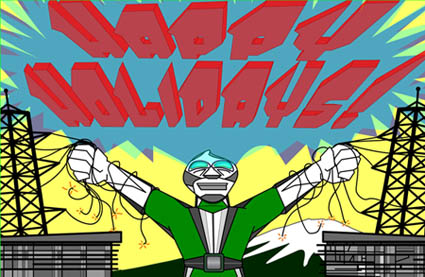
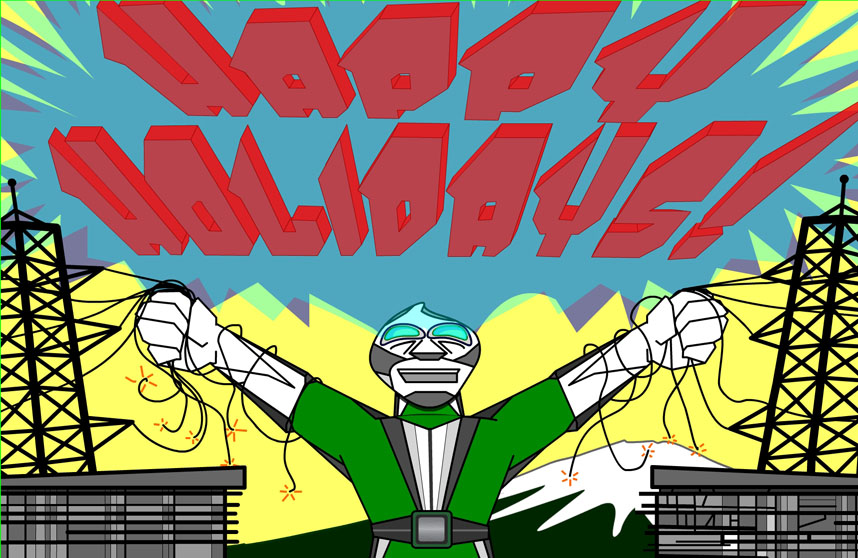
Tinwerks is a Chicago-based company that does ground-up design and manufacture of metal boxes. Chances are that if your special edition DVD boxed set, candy, gum, food, toys, or cigars came in an uber-cool tin, these guys did it.

Now that I think about it, this is actually the fourth card design I sent them in 2009. The first one was this . . .

click for full image
(click image for detail)

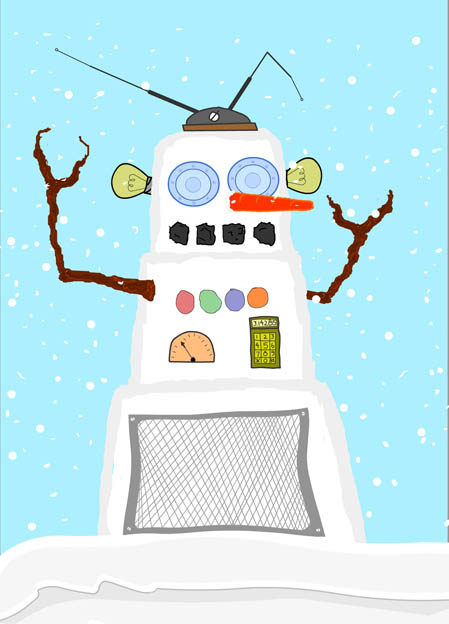
. . . but they weren’t feeling it, for some reason. So I sent them this . . .

robosnowangel.jpg
(click image for detail)

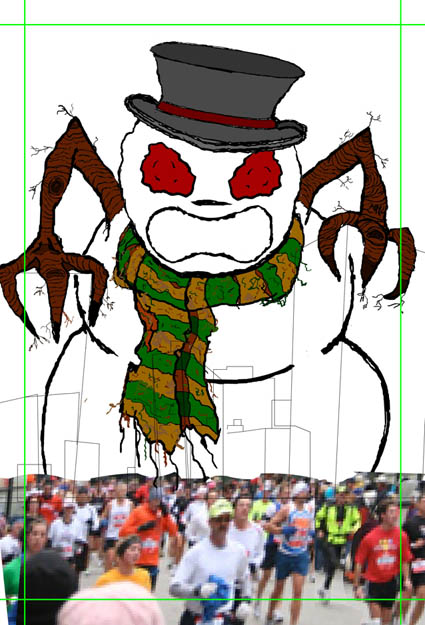
. . . which they said was still a bit too corporate. They were looking for something that jumped off the page, something that would show they were a breed apart. Discussion still revolved around robots and snowmen and this and that . . . and then I came up with a giant snowman attacking Tokyo.

Instant love. Do it.

But before getting too far into this version, I sent the Big Bosses the following:

tw09_snowman_terror.jpg
(click image for detail)

The idea being that the runners would be redrawn as a fleeing mob, include some 1950s jets flying around and a pair of insets with shocked citizens and scientist in the bottom corners. Go for a total movie poster look.

And they loved it! They said it was the best Iron Maiden Christmas card they’d ever seen, which I took as a high compliment. But the image was not quite, er, corporate enough — didn’t send the right message or something. So, back to the drawing tablet.

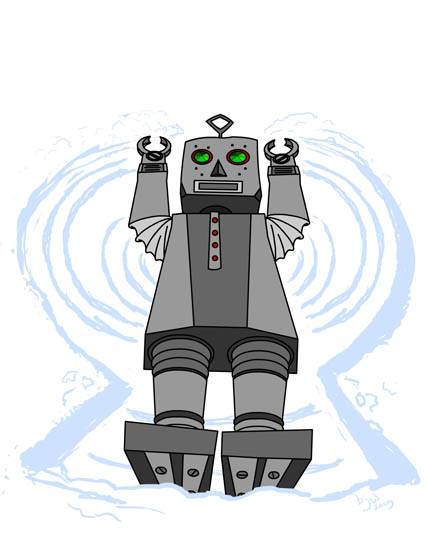
Some more ideas, more back-and-forth and I sent them this one:

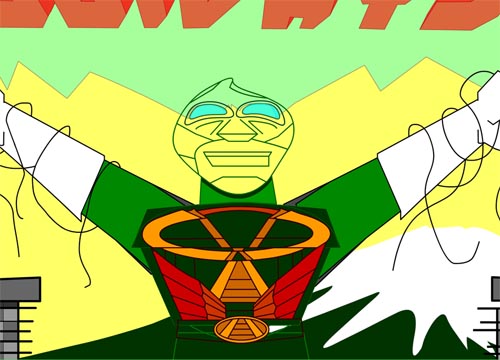
tw09tinnyold.jpg

It’s got the same basic elements as the final product but the chest design on this guy was a bit much. The final robot design has a nice Power Rangers feel to it that the big-wigs really dug. Actually, they went nuts over it. So much so that there was talk of having “Tinny” (as this guy’s now known throughout the company) at trade shows and printed on t-shirts, but it either never happened or I never got a shirt — which is a drag, because I would be wearing it with pride.

twtshirt09_thumb.jpg
click here for full size image

More fine examples of my holiday handiwork coming soon.

Filed Under: Art, Humor, JMS Labs, Work For Hire

Father’s Day Activity Sheet

June 18, 2010 By Bradley Weber

ilh_fathersday_2010.jpg

click to download (638kb)

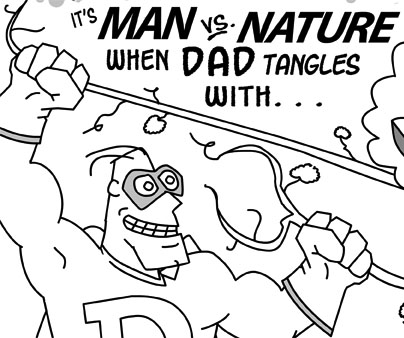
In just under the wire! Print, color and have a Happy Father’s Day. I know I will. Peace.

(special thanks to Bruce Lee , a.k.a., Loston Wallace, over at the PencilJack forum for the Kirby Krackle tutorial. YOU GO NOW. DO IT.)

Filed Under: Art, Coloring Books, JMS Labs, Kid's Menus, Kid's Stuff

  • « Go to Previous Page
  • Page 1
  • Page 2
  • Page 3
  • Page 4
  • Interim pages omitted …
  • Page 7
  • Go to Next Page »

Primary Sidebar

View Book

Recent Posts

  • Famous Feztonians: Francois Anatole
  • Fez Fest!
  • Complex Partial: A Poem About Seizures
  • Book Review: Lemons
  • Shipwrecked (A Poem About Being Shipwrecked)

Archives

Categories

24-Hour Comics Apparel Art Audio Books Book Reviews Book Reviews Coloring Books Comics Drinking Editorials Fear & Loathing Fez Fest Food Gadgets and Toys General History Humor JMS Labs Kid's Menus Kid's Stuff Language Movies Music News Poetry Random Random Art Science! Shakespeare In Comics Stories Tools and Weapons Uncategorized Web sites Weridness Work For Hire Writing Zombies

Categories

  • 24-Hour Comics
  • Apparel
  • Art
  • Audio Books
  • Book Reviews
  • Book Reviews
  • Coloring Books
  • Comics
  • Drinking
  • Editorials
  • Fear & Loathing
  • Fez Fest
  • Food
  • Gadgets and Toys
  • General
  • History
  • Humor
  • JMS Labs
  • Kid's Menus
  • Kid's Stuff
  • Language
  • Movies
  • Music
  • News
  • Poetry
  • Random
  • Random Art
  • Science!
  • Shakespeare In Comics
  • Stories
  • Tools and Weapons
  • Uncategorized
  • Web sites
  • Weridness
  • Work For Hire
  • Writing
  • Zombies

Recent Comments

  • Glenn E. Smith on The Continental Shelf
  • bjw on Is this Bat Country?
  • Nick Sizer on Is this Bat Country?
  • deg on Soul Train Host Was Former Chicago Cop
  • Agent Joe on Book Review: The Big Book Of Adventure Stories

Copyright © 2026 · Bradley James Weber